By phone or email
To speak to an adviser, please call our free and confidential advice line 0808 801 0366 (Monday to Friday 9.30am to 3pm, excluding Bank Holidays). Or you can ask us a question via email using our advice enquiry form.
How to contact us for advice

Are you a parent, kinship carer relative or friend of a child who is involved with, or who needs the help of, children’s services in England? We can help you understand processes and options when social workers or courts are making decisions about your child’s welfare.
Our advice service is free, independent and confidential.
To speak to an adviser, please call our free and confidential advice line 0808 801 0366 (Monday to Friday 9.30am to 3pm, excluding Bank Holidays). Or you can ask us a question via email using our advice enquiry form.
Our online advice forums are an anonymous space where parents and kinship carers (also known as family and friends carers) can get legal and practical advice, build a support network and learn from other people’s experiences.
Our get help and advice section has template letters, advice sheets and resources about legal and social care processes. On Monday and Thursday afternoons, you can use our webchat service to chat online to an adviser.

The information and advice on this page explains more about deprivation of liberty orders (‘DOLs’) which are made using the High Court’s inherent jurisdiction. It is for families and includes information about when children’s social services may apply for a ‘DOLs’ order. And how the High Court decides whether to use its inherent jurisdiction to make a ‘DOLs’ order and where your child might live if it does.

A deprivation of liberty order is an order made by the High Court using a power called the inherent jurisdiction. Children’s social services apply for this when they want to deprive a child of their liberty somewhere which is not a secure children’s home. Sometimes people refer to them as ‘DOLs orders’ or just ‘DOLs’.
DOLs orders can be made in respect of a child who is under the age of 18. Most of the children who are subject to the orders are also looked after in the care system. DOLs orders must set out the ways the child’s freedom may be restricted. For example, whether a child can be physically restrained. Or how many people may supervise them. Children’s social services can only deprive the child of their liberty in the ways specifically set out in the court order.

The inherent jurisdiction is a power held by the High Court of England and Wales. It can be drawn on where what needs to be done to protect or care for a child cannot be achieved under other child welfare legislation.
Decisions in the High Court are made by senior judges. The High Court has extra powers that the Family Court does not. The inherent jurisdiction is one of those powers. It is this power that a High Court judge uses to make a deprivation of liberty order (DOLs). The law places some limits on how the use of the inherent jurisdiction powers may be used (see section 100 of the Children Act 1989). For example, the inherent jurisdiction powers cannot be used to decide whether a child should be placed in the care of children’s social services.
1. Why might children’s social services apply for a High Court deprivation of liberty order (DOLs)?
Children’s social services apply to the High Court for a deprivation of liberty order when they want to deprive a child of their liberty in a setting which is not a secure children’s home. Only the High Court has powers to allow this to happen.
There can be different reasons why a child who needs to be deprived of their liberty cannot move to a secure children’s home. These include:
If children’s social services wanted a child to live in a secure children’s home they would apply for a secure accommodation order instead. That is an order that the Family Court can make.
For information and advice about secure children’s homes and secure accommodation orders see: What do families need to know about secure accommodation orders?
2. How does the High Court decide whether to make a deprivation of liberty order (DOLs)?
There are seven things the court needs to look at when making a deprivation of liberty order under the High Court’s inherent jurisdiction:
To find out more about the human rights to liberty and to a private and family life please see Deprivation of liberty (DOLs) and secure accommodation orders for children.
3. How long does a deprivation of liberty order (DOLs) last?
A deprivation of liberty order should only last for as long as it is in the child’s best interests and is necessary to keep the child safe and well.
Children’s social services can only restrict a child’s freedom in the specific ways set out in the DOLs order. But they should only use those restrictions if they are needed to keep the child safe and well. This means:
Children’s social services have a general legal duty to keep any child who is looked after in the care system safe and well cared for (see section 22(3) of the Children Act 1989). This duty applies to any child who is ‘in care’ under a court order. And to any child looked after under voluntary arrangements. It is a duty that applies whatever the reason a child has become looked after.
There are a range of things children’s social services must as part of this duty. For example, making sure the views of parents, carers and the child are taken into account when key decisions are being made about the child. These duties still apply when the child is being deprived of their liberty.
The main duties children’s social services have to a looked after child
Open or download this table to see the main duties children’s social services have. It describes each legal duty, where it can be found and whether it applies to:
What it means when a child is described as “looked after”
In England, if a child is described as a ‘looked after’ child it means that children’s services are responsible for:
Some looked after children enter or remain in the care system under a court order. This is because the Family Court has decided that is in their best interests and that that children’s services should have parental responsibility for them. These children are described as being ‘in care’.
Other children are looked after in the care system under a voluntary arrangement. A voluntary arrangement can be put in place without any court oversight. It is not a court order. Children’s services do not have parental responsibility for a child looked after under a voluntary arrangement. So, children in voluntary arrangements are not described as being ‘in care’. Instead, they are described as ‘accommodated’ by children’s services.
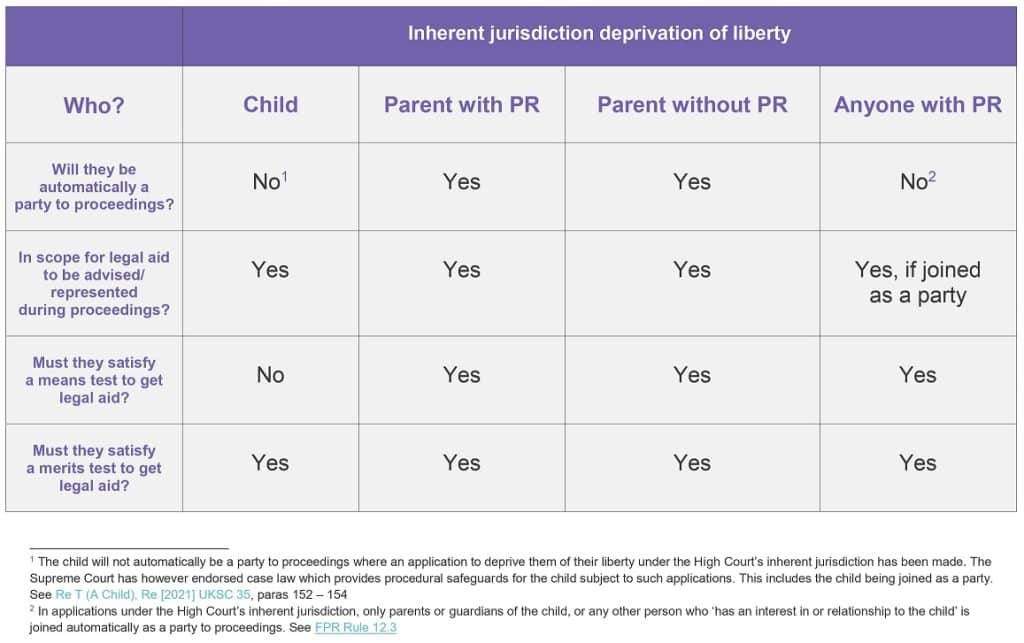
When children’s social services apply for a deprivation of liberty order (DOLs), some people will be fully involved from the beginning. This is because they are automatically respondents to the application. They will be a party to the proceedings and should receive most of the paperwork the High Court will look at. They will be able to attend the court hearings and give their views to the judge.
There are others who will not automatically be a party to the proceedings. But they will be told in writing about the application for the High Court deprivation of liberty order. This is called being given notice of proceedings.
The child
The child is not automatically a party to proceedings. But they can be made a party by the court. Case law has told us that any child who is the subject of such an application to deprive them of their liberty should be joined as a party. If the child is joined as a party, then a children’s guardian must be appointed for them (Family Procedure Rules rule 16.4).
The child’s parents
The child’s parents will automatically be made a party to proceedings. This includes parents without parental responsibility.
Testamentary guardians appointed to care for the child
A testamentary guardian is someone appointed to care for the child. This typically occurs where a child’s parents have died and they appointed a guardian for their child in their will. If the child has a testamentary guardian, that guardian will automatically be joined as a party to proceedings.
Anyone with an interest in or relationship with the child
The law says anyone who has an interest in or relationship to child will be a party to proceedings. It is likely this will include those who have parental responsibility for the child. Such as a kinship carer with a child arrangements order or special guardianship order.
In some situations it may include someone in the wider child’s network who does not have parental responsibility. This could be someone who is important to the child and closely involved in their life. Or a kinship carer who is raising the child but does not have parental responsibility for them. That person would need to show they do have an interest or relationship with the child before they could be a party to the proceedings.
You can find more detailed information and advice about whether you will qualify for legal aid in deprivation of liberty proceedings here.

When children’s social services apply for a deprivation of liberty order (DOLs), the child is not automatically a party to proceedings. But they can be made a party by the court. Decisions from senior judges (case law) says a child who is the subject of an application to deprive them of their liberty should be joined as a party.
The court must appoint a children’s guardian for the child. A children’s guardian usually works for an organisation called CAFCASS which is independent of children’s social services. Their role is to represent the interests of the child. This involves:

Sometimes, the child and their Guardian disagree on what is the best plan. In these situations, the child may be able to separate from their Guardian. This means the child will give instructions directly to their solicitor. A child can only do this if they have sufficient understanding.
Whether a child has sufficient understanding to instruct a solicitor directly will depend on the precise situation and several different factors including:
Legal aid is the use of government money to pay for people to receive free legal advice and representation. Legal aid may be available for the family of a child when children’s social services apply for a deprivation of liberty order (DOLs). And is very likely to be available to the child.
Our legal aid page includes information about:

Your donation will help more families access expert legal advice and support from Family Rights Group.
Donate Now