By phone or email
To speak to an adviser, please call our free and confidential advice line 0808 801 0366 (Monday to Friday 9.30am to 3pm, excluding Bank Holidays). Or you can ask us a question via email using our advice enquiry form.
How to contact us for advice

Are you a parent, kinship carer relative or friend of a child who is involved with, or who needs the help of, children’s services in England? We can help you understand processes and options when social workers or courts are making decisions about your child’s welfare.
Our advice service is free, independent and confidential.
To speak to an adviser, please call our free and confidential advice line 0808 801 0366 (Monday to Friday 9.30am to 3pm, excluding Bank Holidays). Or you can ask us a question via email using our advice enquiry form.
Our online advice forums are an anonymous space where parents and kinship carers (also known as family and friends carers) can get legal and practical advice, build a support network and learn from other people’s experiences.
Our get help and advice section has template letters, advice sheets and resources about legal and social care processes. On Monday and Thursday afternoons, you can use our webchat service to chat online to an adviser.

The information and advice on this page is for families. It explains more about secure accommodation orders and when children’s social services apply for them. The page looks at how the Family Court decides whether to make a secure accommodation order and how long they can last. You can also learn more about secure children’s homes and about secure accommodation reviews.
A secure accommodation order is an order the Family Court can make. Children’s social services apply for this order if they want a child to live in a secure children’s home for more than 72 hours. When children’s social services apply for a secure accommodation order they are asking the Family Court to:
The Family Court’s powers to make a secure accommodation order come from section 25 of the Children Act 1989.
A secure children’s home is a type of residential home for children. Sometimes people call secure children’s homes ‘secure accommodation’ or a ‘secure unit’. A child may be being cared for in a secure children’s home because they pose a risk to themselves, or because they are a risk to others.
A child who is living in a secure children’s home is being deprived of their liberty. This means they are not free to leave and staff may restrain the child to:
Is a child who lives in a secure children's home deprived of their liberty?
Yes, a child who is living in a secure children’s home is being deprived of their liberty. This means they are not free to leave and staff may restrain the child to:
When can arrangements be made for a child to live in a secure children’s home?
This can only happen if a child is:
It is a serious step to deprive a child of their liberty in a secure children’s home. There are many different legal rules that must be met first. The specific rules that apply depend on the age of the child and how long it is planned that they live in a secure children’s home for.
Who runs secure children’s homes?
Secure children’s homes may be run by local councils. Some secure children’s homes are run by voluntary organisations. And some are run by private firms.
In England, all children’s homes must be registered with OFSTED. OFSTED is the government body that inspects and regulates services that care for children. It is illegal not to register a children’s home with Ofsted.
Before a children’s home can be used as a secure children’s home the government must first approve this. This approval comes from the Secretary of State – a senior minister responsible for the government’s work in relation to children in the care system. The Secretary of State will receive information about the children’s home. Then they will decide whether to agree to the children’s home being used to deprive children of their liberty.
The law about this comes from:
What records must secure children’s homes keep?
Secure children’s homes must keep records of:
The law about recording keeping in secure children’s homes comes from The Children (Secure Accommodation) Regulations 1991.
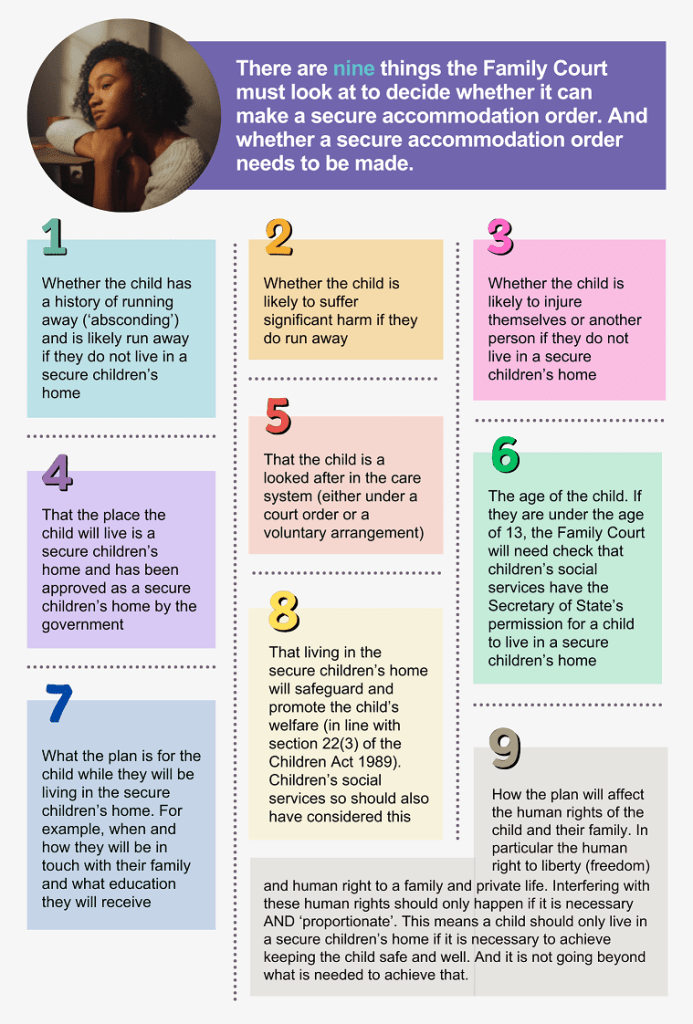
You can download a screen reader friendly version of this FAQ, as well as a copy of the graphic, using the download button below.
All of this is set out in the law. The law comes from:
If a child is moved to a secure children’s home, and children’s social services plan to apply for a secure accommodation order, they must try to inform the following people as quickly as possible:
See Regulation 14 of the Children (Secure Accommodation) Regulations 1991.
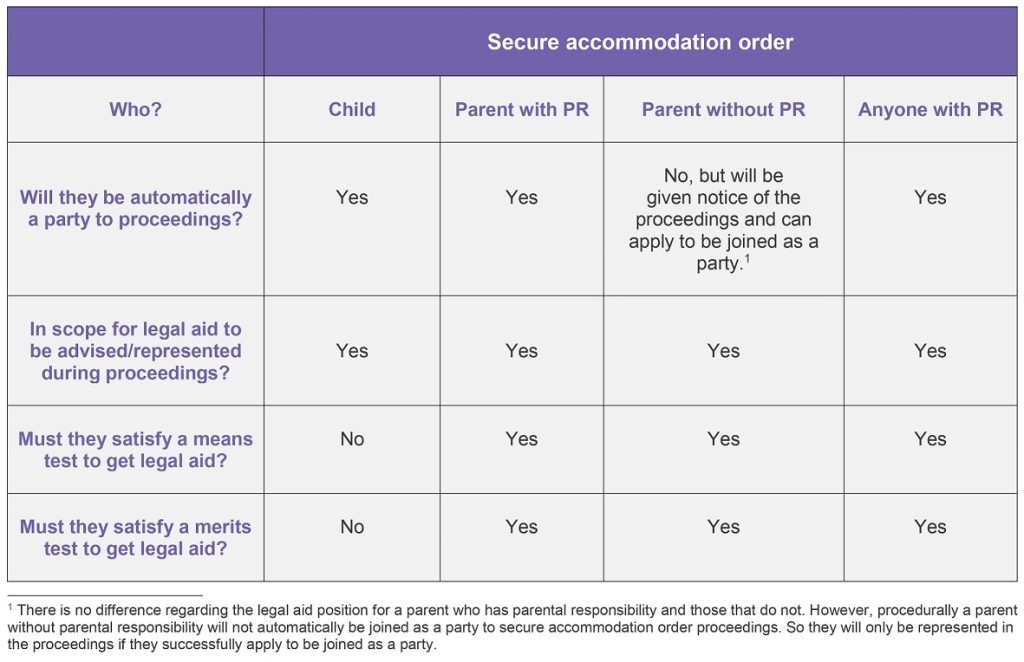
When children’s social services apply for a secure accommodation order, some people will be fully involved from the beginning. This is because they are automatically respondents to the application. This means they will be a party to the proceedings and should receive most of the paperwork the Family Court will look at when deciding whether or not to make the secure accommodation order.
There are others who will not automatically be a party to the proceedings. But the will be told in writing that the application for a secure accommodation order has been made. This is called being given notice of proceedings.
The child
The child who will be the subject of the secure accommodation order if it is made will automatically be a party.
Any parent with parental responsibility
Any parent with parental responsibility will automatically be a party.
Anyone else who has parental responsibility for the child
Any parent with parental responsibility will automatically be a party. This includes kinship carers who have parental responsibility because they hold a child arrangements order or special guardianship order for the child.
A parent without parental responsibility
A parent who does not have parental responsibility will not automatically be a party to the proceedings. But they should be given notice. This means they should be written to and told that an application for a secure accommodation order has been made. They can then apply to the Family Court to become a party, if they wish. Whether the Family Court decides to make them a party depends on the precise situation.
You can find more detailed information and advice about whether you will qualify for legal aid in secure accommodation proceedings here.

The child will automatically be a respondent to the application and will therefore be a party to the proceedings.
The court must appoint a guardian for the child. The child’s guardian usually works for an organisation called CAFCASS which is independent of children’s social services. Their role is to represent the interests of the child. This involves:
The child will not have a Guardian if the Family Court decides that it is not necessary to appoint a child’s guardian to safeguard the child’s interests.

Sometimes, the child and their Guardian disagree on what is the best plan. In these situations, the child may be able to separate from their Guardian and give instructions directly to their solicitor. A child can only do this if they have sufficient understanding. Whether they do will depend on the precise situation including:
The law says a court cannot make a secure accommodation order in respect of a child who is not legally represented. There is one exception to this; where the child has been informed of their right to apply for legal aid, had the opportunity to apply, but refused or failed to do so.
See Section 25 of the Children Act 1989 and the Family Procedure Rules.
If a child is looked after in the care system, only the children’s social services department looking after them can apply for a secure accommodation order.
Where a child is not looked after by children’s social services, but is living away from home, the setting the child is living in may be able to apply for a secure accommodation order. Settings that can apply include:
See Regulation 2 of the Children (Secure Accommodation) (No. 2) Regulations 1991).
Government regulations called The Children (Secure Accommodation) Regulations 1991 explain how long a secure accommodation order can be made for.
The Family Court has the power to first make a secure accommodation order for a maximum period of 3 months. This is known as the ‘initial period.’
If after 3 months, children’s social services think the child should continue to live in the secure children’s home, they will need to apply for a further secure accommodation order. The Family court can authorise a child to be kept in secure children’s home for a maximum period of up to 6 months.
If after 6 months, children’s social services think the child should continue to live in the secure children’s home, they will need to apply for a further secure accommodation order. But the maximum period of time that any other secure accommodation order can last will be six months.
Different rules will apply if the secure accommodation order is being made for a child who is remanded by a criminal youth court to the care of the local authority.
The Family Court has power to make an interim secure accommodation. This is an order which will be made for a shorter time, and until the Family Court have more time to think about the application for a secure accommodation order. And whether they should make the order. An interim secure accommodation order allows children’s social services department to move a child to move to a secure children’s home and live there for the duration of the interim order. See section 25(5) of the Children Act 1989.
Yes, the Family Court have the power to make a secure accommodation order for a 16- or 17-year-old who is looked after by children’s social services. But there is one exception to this: the court cannot make a secure accommodation order if the 16- or 17-year-old is looked after by children’s social services under a voluntary arrangement made under section 20 (5) of the Children Act 1989.
Section 20 (5) of the Children Act 1989 allows children’s social services to provide accommodation for a young person aged between 16 and 21 in a community home. They can do this if they think it will safeguard or promote the young person’s welfare. This means children’s social services can provide this accommodation if they think it will keep the young person safe and that it will be in the young person’s best interests to live there.
If your child is 16 or over and looked after by children’s services under a voluntary arrangement, you can ask children’s services what part of section 20 of the Children Act 1989 they are using to provide the accommodation.
The law for this comes from:
A secure accommodation order review is where practitioners working with the child meet to discuss whether:
Secure accommodation reviews are different to the type of reviews that must take place for every looked after child (sometimes called LAC reviews).
When must a secure accommodation review take place?
A secure accommodation review must take place:
Who is involved in a secure accommodation order review?
Three people carry out a secure accommodation review. They must be appointed by the children’s social services department looking after the child. At least one person must not work for the children’s social services department.
What must a secure accommodation review look at?
The three people carrying out the review must have regard to the child’s welfare. This means they must think about what is best for the child when they are carrying out the review. They must also try to gather and take into account the wishes and feelings of:
See Regulations 15 and 16 of Children (Secure Accommodation) Regulations 1991).
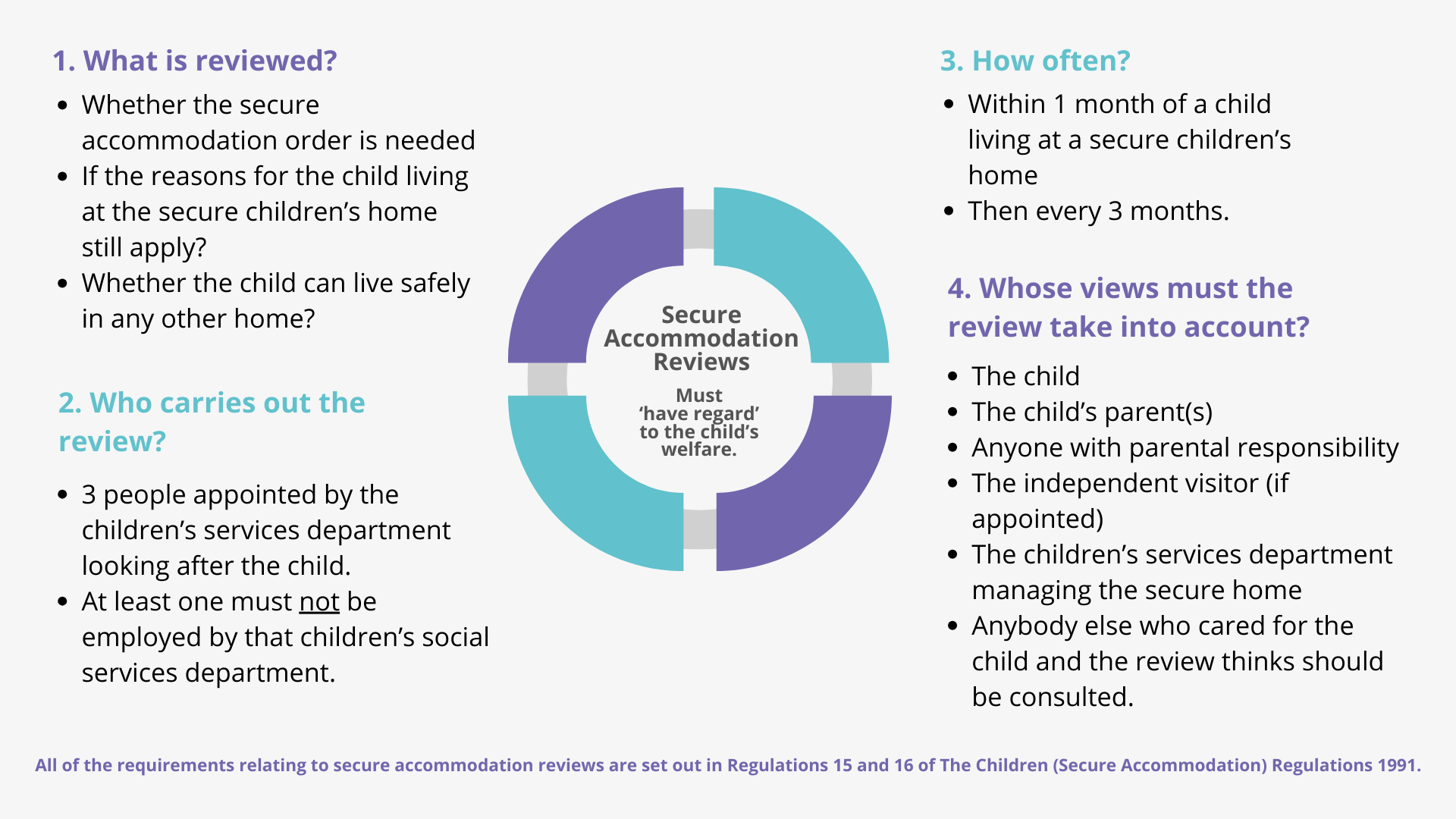
You can download a screen reader friendly copy of this overview using the download button below.
Legal aid is the use of government money to pay for people to receive free legal advice and representation. It may be available for families when children’s social services apply for a secure accommodation order. And is very likely to be available to the child.
Visit our legal aid page for information about:

Your donation will help more families access expert legal advice and support from Family Rights Group.
Donate Now