By phone or email
To speak to an adviser, please call our free and confidential advice line 0808 801 0366 (Monday to Friday 9.30am to 3pm, excluding Bank Holidays). Or you can ask us a question via email using our advice enquiry form.
How to contact us for advice

Are you a parent, kinship carer relative or friend of a child who is involved with, or who needs the help of, children’s services in England? We can help you understand processes and options when social workers or courts are making decisions about your child’s welfare.
Our advice service is free, independent and confidential.
To speak to an adviser, please call our free and confidential advice line 0808 801 0366 (Monday to Friday 9.30am to 3pm, excluding Bank Holidays). Or you can ask us a question via email using our advice enquiry form.
Our online advice forums are an anonymous space where parents and kinship carers (also known as family and friends carers) can get legal and practical advice, build a support network and learn from other people’s experiences.
Our get help and advice section has template letters, advice sheets and resources about legal and social care processes. On Monday and Thursday afternoons, you can use our webchat service to chat online to an adviser.

Written version of everything said in the film - transcript
Sometimes, people become worried about a child in a family, or about a baby who is about to be born.
They might have worries about how the parent is coping. Or about whether the child is safe, healthy and being well looked after.
The person who is worried may be someone in the child’s family. Or it may be a worker, like a midwife or schoolteacher.
If someone is worried about a child, they can tell children’s services. This is called making a referral. For example, someone could be worried that:
Your local children’s services employ children and family social workers. Their job is to support children and keep children well and safe from harm. You can ask for help as soon as you think your child needs it. Not just when things get really difficult.
If there are worries about a child, a social worker may contact the parent and visit them.
Social Worker: ‘Hi, I’m Sarah. I am a children and families social worker. Can I come in?’
Parent: ‘Can I see your ID please.’
Social Worker: ‘Sure’
When you first meet a social worker, you might feel worried or scared. You may feel worried about letting the social worker into your house.
Many parents feel scared that a social worker may take their child away.
Social workers should always work with your family to keep your child safe and at home where possible.
Social workers cannot remove your child from you unless the Family Court has approved a plan for that to happen. Or if someone with parental responsibility for your child has agreed that the social worker can arrange for your child to live somewhere else.
For example, with another family member or in a foster home. The police have the power to remove a child to a place of safety in an emergency. This is called police protection.
Social workers make ask the police to use police protection if they are worried that a child is in immediate danger, but they do not have time to apply to the court.
When a child is removed by the police under police protection, they will ask children’s services to look after the child. If social worker do not think it’s safe for the child to return home after 72 hours, they will apply to court for an order.
Parent: ‘Yeah ok, come in.’
Remember that the social worker is there to see how your child and you are doing.
The social worker should start off by explaining what their role is and why they are visiting you.
Social Worker:
‘My role is to work with children and families and see if they need any help and support. I’m here because Emma’s school have some worries about her often arriving late and hungry, and how you are coping at home at the moment. Let’s have a chat about how you are getting on and what life is like for Emma at the moment.’
The social worker may tell you they want to do something called an assessment.
The point of an assessment is to understand whether your child is safe, healthy and is being well looked after. And to find out what support your child and family might need.
You may not want a social worker to do an assessment.
You may feel that things are okay or that you do not need support.
You may also want to know if you have a choice about whether the assessment goes ahead.
Sometimes, having a social worker from children’s services to do an assessment for your child is voluntary.
This means that a social worker or another worker will do an assessment only if you, as the child’s parent, agrees.
A child in need assessment is an example of this.
But, if children’s services are worried your child may be at risk of harm, a social worker can do an assessment even if you do not want this to happen.
This is called a child protection enquiry.
If the assessment is a child protection enquiry, the social worker will also try to understand whether your child is being harmed. And what action is needed to keep your child safe.
No matter what type of assessment happens the social worker should always explain:
What the assessment is, and whether you can say yes or no to it
What the worries about your child are
How you, your child and others in your family will be involved
What the assessment will look at and how it will be carried out
How long it will take
And what will happen next.
Remember, if you do not understand anything, you can ask the social worker to go over it again. Because it is important that you understand.
Parent: ‘Sorry, I don’t understand. Can you please tell me again what happens in an assessment?’
Social worker: ‘That’s okay. It’s my job to make sure you know what is happening.’
As part of an assessment, the social worker may want to visit you at home again. This may happen more than once.
They may want to talk to your child separately to understand what life is like for them.
In most situations, the social worker should ask you first before this happens.
You can ask the social worker questions about this. For example, why they want to speak to your child.
If you need some extra support when you meet with the social worker, that is okay.
You may find it helpful to ask a friend or a family member to be there when the social worker visits. Or when you have meetings.
This may help you feel more relaxed and confident.
Parent: ‘This is my mum, Rachel. She is here to support me.’
Social Worker: ‘Hello, Rachel, it’s nice to meet you.’
So, how should social workers work with children, parents and families?
The social worker should not blame you or judge you.
The social worker should talk to you about your strengths as a parent.
Social Worker: ‘It’s great to see you getting Emma’s breakfast ready.’
Parent: ‘Thanks.’
Social Worker: ‘Let’s have a think about how we can make sure she gets to school on time every day. What do you think will help?’
Parent: ‘I run out of money at the end of the month so can’t afford the bus fare to school. Can you help me with this?’
The social worker should take the time to talk to you, to learn more about your child’s life, and to learn more about your daily life as a parent.
They should ask you about other people in your life like your friends, family and neighbours.
They should find out about the ways these people support you and the ways they may be able to support you more.
The social worker will want talk to other workers you know to get more information about you and your child.
They should ask you first if you would be okay with this.
For example, they might ask you if they can talk to your child’s teacher, your doctor, midwife, or health visitor.
They should try to find out what help and support you would like and what you think would work best for you.
Parent: ‘I’m worried about helping Emma with her reading. I would like more support with that.’
The social worker should try and put this support in place for you as soon as you need it. You do not need to wait for the assessment to be over.
They should work with other people to help you.
Sometimes, the social worker may use words you have not heard before.
They may talk quickly or might be in a rush.
Many parents find this confusing. It can be difficult to understand what the social worker means or what might happen next.
The social worker should use simple and clear words that you understand.
If you do not understand something, you can ask them to go over it again.
Parent: ‘I don’t understand what that means, can you explain it again?’
Social Worker: ‘Of course I can, I’ll try to be clearer this time.’
The social worker should share a report about your child with you when they finish the assessment.
They may share other documents with you, too.
Many parents need help to understand these reports.
Here are some ways that the social worker should help you to understand:
Social Worker: ‘Here is an easy-read version of my report. This report uses words and pictures to help you understand what I have written.’
Social Worker: ‘Let’s go through this report together.’
Social Worker: ‘Do you understand what I have written? Is there anything you disagree with?’
You may feel that the social worker is not listening to you.
You may feel that you cannot get your thoughts and point of view across.
Or feel scared or frustrated about what is being said and written about you.
Remember, you can ask the social worker if they can get you an Advocate.
Advocates are independent. So, they are separate from children’s services.
An advocate is someone who helps parents get their views across when dealing with social workers.
For example, an advocate can:
Help you write letters or make telephone calls for you.
Help you understand what is going on in reports and in meetings.
Go to meetings with you to help you have your say.
‘Excuse me, Abi would like to say something.’
Sometimes, you may feel like you want a different social worker to work with you and your child.
This could be for a number of different reasons.
You can speak to your social worker’s manager to ask for a new social worker.
And you can make a complaint if you have concerns about them.
However, children’s services do not have to change the social worker.
If you are worried or confused about something the social worker has said or about what is happening, you can call Family Rights Group.
Family Rights Group is a specialist charity that gives advice to parents and carers when there is a social worker involved with their child.
You can call Family Rights Group on:
0808 801 0366
Somebody will speak to you and help you to understand what is happening.
This person is independent. This means they do not work for children’s services.
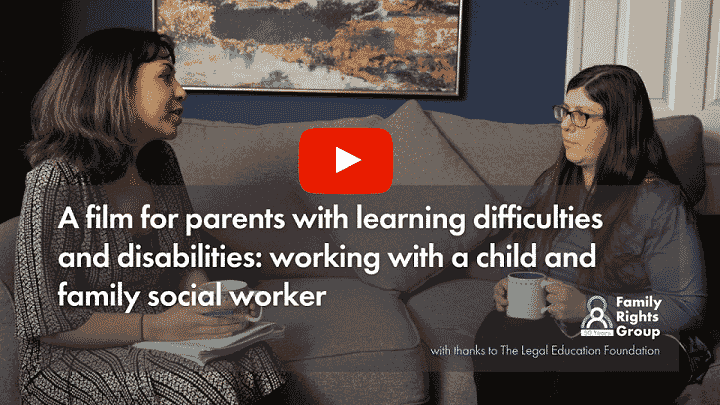
This film is designed to help parents with learning difficulties or disabilities. And those that are supporting them or working with them. The film explains what parents should be able expect when a child and family social worker becomes involved in their child’s life.
It was made in partnership with Speakup Rotherham, an advocacy organisation for people with learning difficulties and disabilities. It was co-produced by parents with experience of the child welfare system. Parents were involved every step of the way, from shaping the content to creating the film itself. As a result, the film reflects their experiences and addresses the challenges they face.
The film breaks down what may happen when a child and family social worker first gets involved in a child’s life. It uses fictional scenes between a social worker and a parent that are based on real life examples.
The film explains some of the steps child and family social workers may take and the processes they should follow. It explains what some of the words they often use mean. The film shows how social workers should communicate and work with parents with learning difficulties and disabilities. It also highlights how parents can make their voices heard and their views known, including the important role of an advocate.
What support may parents with learning difficulties and disabilities benefit from?
Parents with learning disabilities or difficulties may benefit from extra help from a range of services. This includes:
Do children’s services always become involved with a family where a parent has a learning difficulty or disability?
Children’s services will not always become involved with a family where a parent has a learning difficulty or disability . But they may do if they think a child and their family need extra support, or if the child or family ask for this. Or if they are worried a child is not safe or well cared for.
See our Children’s services page for:
How should children’s services work with parents with learning difficulties and disabilities?
Children’s services should look at children and parents as individuals. They should look at their specific needs.
Children’s services should always work in partnership with children and families. And where a parent has a learning difficulty or disability it is important children’s services follow Good practice guidance on working with parents with a learning disability.
The guidance is based on five features of good practice. You can read more about these features here on ‘adults with learning difficulties and disabilities’ webpage.
What help and advice does Family Rights Group offer?
Family Rights Group offers free, independent and confidential advice for parents, kinship carers, relatives and friends of children who are involved with children’s services in England or need their help. We support families to work with social workers and understand the law, their rights and options.
This Easy Read leaflet explains what our advice services does and how you can get in touch with us.
Where can parents with learning difficulties and disabilities get further help and advice?
There are specialist organisations and networks which support parents with learning difficulties and disabilities. See the Disability (including learning disability) section of our Useful links page for further information.
Contact details for local council adult social care departments can be found by entering your postcode or town into this search tool on the NHS website.
Updated: March 2026

Your donation will help more families access expert legal advice and support from Family Rights Group.
Donate Now